

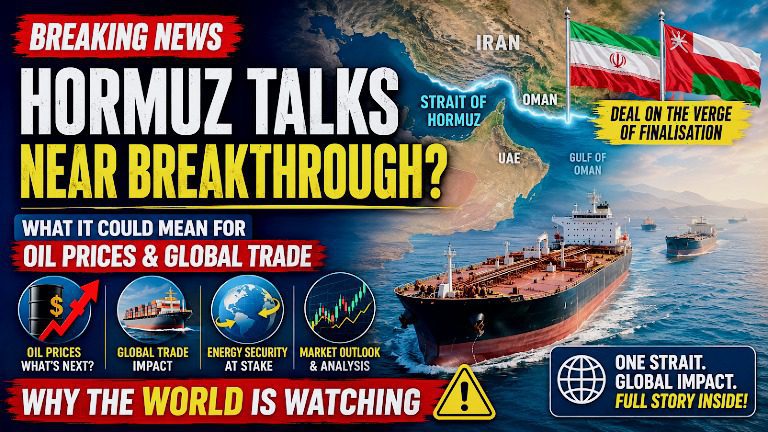
Strait of Hormuz Talks Near Breakthrough: Why a Shipping Agreement Could Reshape Global Energy Markets
Strait of Hormuz Negotiations Enter a Critical Phase
Diplomatic efforts aimed at restoring commercial shipping through the Strait of Hormuz appear to be entering an important stage, with regional discussions raising hopes that one of the world’s most strategically significant maritime routes could soon see increased commercial activity.
While no final agreement has been officially announced, recent developments indicate that negotiations involving regional stakeholders are progressing. Any breakthrough could have major implications for international trade, crude oil prices, shipping costs, and overall global economic stability.
The Strait of Hormuz remains one of the busiest energy corridors in the world. Every day, millions of barrels of crude oil and large volumes of liquefied natural gas (LNG) normally pass through the narrow waterway, connecting Gulf producers with customers across Asia, Europe, and other international markets.
Because of its strategic location, even temporary disruptions can influence energy prices and financial markets worldwide.
Why the Strait of Hormuz Is So Important
The Strait of Hormuz connects the Persian Gulf with the Gulf of Oman and the Arabian Sea, making it one of the world’s most critical maritime chokepoints.
Several major energy-producing nations depend on this route to export crude oil and natural gas. Countries including Saudi Arabia, Iraq, Kuwait, the United Arab Emirates, Qatar, and Iran all rely heavily on uninterrupted maritime access for international trade.
A prolonged disruption can affect:
Global crude oil supplies
LNG exports
International shipping schedules
Marine insurance costs
Inflation across energy-importing countries
Global financial market sentiment
Because such a large share of global energy exports moves through this corridor, investors closely monitor every diplomatic or military development related to the region.
Why Markets Are Watching Closely
Energy markets react quickly to uncertainty involving key shipping routes.
Whenever concerns arise about the movement of oil tankers, traders often anticipate possible supply disruptions. That uncertainty can increase crude oil prices even before any actual reduction in exports occurs.
Higher energy prices can then influence:
Transportation costs
Manufacturing expenses
Aviation fuel prices
Food inflation
Currency movements
Equity market volatility
Countries that import significant amounts of crude oil, including India, generally monitor these developments carefully because sustained increases in oil prices may affect inflation and the trade balance.
Diplomatic Engagement Offers Hope
Recent diplomatic engagement has renewed optimism that commercial navigation could gradually return to more predictable conditions.
Regional mediation has played an important role in encouraging dialogue among stakeholders with differing security and commercial priorities.
Observers believe practical discussions covering navigation safety, shipping coordination, maritime security, and technical arrangements are essential before commercial traffic can fully normalize.
Even if an initial framework is reached, experts expect implementation to occur gradually as confidence among shipping companies and insurers improves.
Shipping Industry Remains Cautiously Optimistic
International shipping companies continue to assess security conditions before expanding operations through sensitive maritime corridors.
Commercial operators typically evaluate several factors before increasing vessel movements, including:
Safety assessments
Insurance availability
Naval security arrangements
Port accessibility
Navigation guidance
Regional political stability
A clear operational framework could encourage more shipping companies to resume regular schedules, although many are expected to remain cautious during the initial stages.
Energy Prices Could Respond Quickly
One of the most immediate consequences of progress in negotiations could be improved confidence in energy markets.
If traders believe the risk of prolonged supply disruption is declining, crude oil prices could stabilize. Lower volatility would benefit importing countries, airlines, manufacturing industries, logistics companies, and consumers.
However, analysts caution that energy markets remain highly sensitive to geopolitical developments, meaning prices could continue fluctuating until long-term stability is established.
India’s Perspective
India imports a significant share of its crude oil requirements, making developments around the Strait of Hormuz particularly important.
Stable maritime trade through the region can help:
Improve energy security
Support stable fuel supplies
Reduce pressure on import costs
Improve inflation outlook
Strengthen investor confidence
Businesses involved in aviation, transportation, logistics, chemicals, and manufacturing also closely monitor global energy prices because fuel represents a major operating expense.
Investors Continue Monitoring Global Risks
Financial markets increasingly respond not only to corporate earnings but also to geopolitical developments.
Institutional investors continue tracking:
Energy supply chains
Commodity prices
Shipping activity
Currency markets
Central bank policy
Global inflation trends
Any improvement in maritime stability could contribute to stronger market confidence, while renewed uncertainty may increase volatility across commodities and equities.
Looking Ahead
Although discussions appear to be progressing, the long-term success of any arrangement will depend on consistent implementation, effective communication among participating parties, and confidence from international shipping operators.
Energy markets, investors, governments, and businesses will continue watching developments closely over the coming weeks. Even incremental progress toward safer commercial navigation could influence global trade flows and economic expectations.
For now, the Strait of Hormuz remains one of the world’s most closely watched maritime corridors, with its future carrying significant implications far beyond the Middle East.
Global Oil Markets Could See Relief if Maritime Stability Improves
The international energy market remains highly sensitive to disruptions affecting major shipping routes. Even the possibility of interruptions can trigger rapid changes in crude oil prices as traders adjust expectations about future supply.
If commercial navigation becomes more predictable, energy markets could gradually experience lower volatility. Stable shipping conditions would reduce uncertainty for refiners, importers, exporters, and logistics companies that depend on uninterrupted energy flows.
However, analysts caution that energy prices are influenced by multiple factors beyond maritime security, including global demand, production decisions by major oil-producing nations, inventory levels, and broader economic conditions.
Impact on Global Trade
The Strait of Hormuz is not only important for oil exports but also for broader international commerce. Numerous cargo vessels carrying industrial products, chemicals, raw materials, and manufactured goods transit nearby shipping routes.
Improved maritime stability could help:
Reduce freight uncertainty
Improve shipping schedules
Lower insurance-related costs
Increase confidence among international traders
Support smoother global supply chains
Businesses involved in international trade often monitor geopolitical developments because shipping disruptions can delay deliveries and increase transportation expenses.
India’s Economic Outlook
For India, developments affecting global crude oil prices are especially significant because the country imports a large portion of its energy requirements.
A more stable energy market could provide several potential benefits:
Better control over imported fuel costs
Reduced inflationary pressure
Improved fiscal planning
Greater confidence for businesses dependent on fuel-intensive operations
Sectors such as aviation, logistics, transportation, manufacturing, and chemicals generally benefit from greater stability in global energy prices.
Financial Markets May Continue to React
Global investors closely follow geopolitical developments because they influence commodity prices, currencies, bond markets, and equities.
Periods of uncertainty often lead investors toward defensive assets, while improving diplomatic conditions may encourage greater participation in equity markets and other risk-oriented investments.
Although markets typically respond quickly to headlines, long-term investor confidence generally depends on sustained stability rather than short-term announcements.
Importance of Regional Diplomacy
Diplomatic engagement plays a critical role in reducing tensions in strategically important regions. Constructive dialogue, technical cooperation, and confidence-building measures can help lower risks while supporting international commerce.
Regional mediation efforts often provide opportunities for practical solutions that address commercial navigation, maritime safety, and broader economic interests.
Many international observers believe that continued diplomatic communication remains essential for maintaining long-term regional stability.
What Businesses Should Watch
Companies with exposure to international trade and energy costs should continue monitoring:
Crude oil price trends
Shipping insurance costs
Freight rates
Supply chain developments
Currency movements
Global inflation data
Official diplomatic announcements
Monitoring these indicators can help businesses better understand potential risks affecting operating costs and future planning.
Key Takeaways for Investors
Rather than reacting solely to short-term news, investors may benefit from evaluating broader economic fundamentals alongside geopolitical developments.
Areas worth monitoring include:
Global energy demand
Inflation expectations
Central bank policy
Corporate earnings
Commodity price movements
International trade conditions
Diversification, disciplined research, and a long-term investment approach remain important regardless of near-term market volatility.
Conclusion
Developments involving the Strait of Hormuz continue to attract worldwide attention because of the waterway’s importance to global energy supplies and international commerce.
While diplomatic discussions may improve confidence, the ultimate impact will depend on successful implementation, sustained regional cooperation, and the willingness of commercial operators to resume normal shipping activity.
For governments, businesses, and investors alike, the coming weeks will remain important as markets assess whether diplomatic progress translates into lasting improvements in trade and energy security.
Although uncertainty remains, continued dialogue offers the possibility of reducing risks that have affected global markets in recent months. The situation will likely remain a key focus for policymakers, energy companies, financial markets, and international shipping operators.
FAQs
1. Why is the Strait of Hormuz important?
The Strait of Hormuz is one of the world’s most significant maritime routes, carrying a substantial share of global crude oil and liquefied natural gas exports.
2. How can developments in the Strait of Hormuz affect oil prices?
Any disruption or uncertainty involving shipping through the waterway can influence market expectations about energy supplies, which may lead to increased price volatility.
3. Why does India closely monitor developments in the Strait of Hormuz?
India imports a large portion of its crude oil requirements. Stable maritime trade can help support energy security and reduce pressure from higher import costs.
4. How does the Strait of Hormuz influence global trade?
Besides energy exports, the region is an important route for international shipping, making it relevant for supply chains and global commerce.
5. Should investors monitor geopolitical developments?
Yes. Geopolitical events can influence commodity prices, inflation, currencies, and financial markets. Investors should combine geopolitical analysis with company fundamentals and economic data before making investment decisions.
Disclaimer
Disclaimer: This article is intended solely for informational and educational purposes. It is based on publicly available information and general analysis. It should not be interpreted as investment, legal, political, or professional advice. Readers are encouraged to refer to official statements and trusted sources for the latest updates on ongoing international developments.
Do Follow For More Info @ http://roydailyupdate.in
Do WhatsApp @ https://chat.whatsapp.com/K5POJK9KbpN8egjjOCaOw6
About the Author
Ravi H. Irannanavar is the founder and editor of Roy Daily Update, covering global affairs, business, financial markets, technology, government policy, and breaking news. His reporting focuses on presenting complex developments in a clear, balanced, and reader-friendly manner while emphasizing accuracy and reliable public information.