

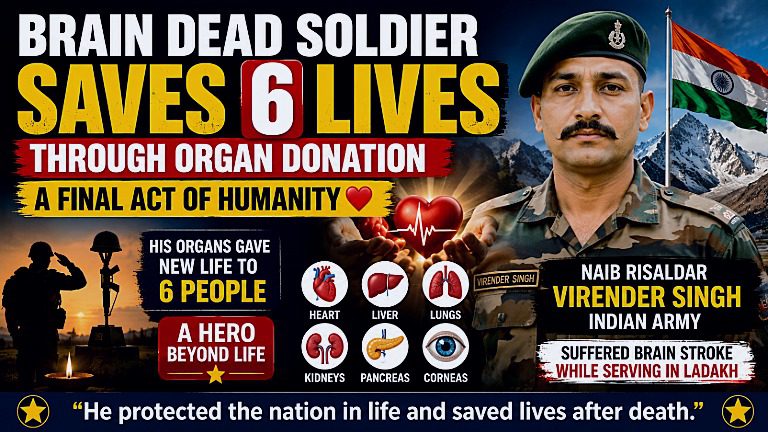
Brain-Dead Indian Army Soldier Saves Six Lives Through Organ Donation
In a remarkable story of courage, sacrifice, and compassion, Naib Risaldar Virender Singh of the Indian Army has left behind a legacy that extends far beyond the battlefield. After suffering a severe brain stroke while serving in the challenging high-altitude region of Ladakh, the soldier was declared brain dead. In an extraordinary act of generosity, his family chose to donate his organs, giving six critically ill patients a second chance at life.
The inspiring decision has touched millions across the country and highlighted the life-saving importance of organ donation.
Soldier Suffered Brain Stroke While Serving in Ladakh
Naib Risaldar Virender Singh was posted in the high-altitude terrain of Ladakh, one of the most demanding operational environments for Indian soldiers.
While performing his duties, he reportedly suffered a severe brain stroke. Despite medical efforts, doctors declared him brain dead.
His death became a heartbreaking moment for fellow soldiers, family members, and the Indian Army.
However, even in tragedy, his story became one of hope.
Family’s Noble Decision Saves Six Lives
Following medical confirmation of brain death, Virender Singh’s family made a courageous decision to donate his organs.
The donation enabled doctors to transplant multiple organs into patients suffering from life-threatening illnesses.
According to the Indian Army, the soldier’s final act of kindness has given six people a new lease on life.
The family’s selfless decision has been widely praised across the country.
Indian Army Pays Emotional Tribute
The Western Command of the Indian Army paid tribute to Naib Risaldar Virender Singh and his family through an emotional message shared on social media platform X.
The Army described the organ donation as an act that represents humanity beyond sacrifice.
According to the Army’s statement:
“In a heart-wrenching yet profoundly inspiring act of sacrifice, Nb Risaldar Virender Singh, declared brain dead after suffering a brain stroke while performing duty in the high-altitude Ladakh region, left behind a lasting legacy of humanity by the noble act of organ donation.”
The Army further noted that his legacy will continue to inspire both soldiers and civilians.
Why High-Altitude Duty Is So Challenging
Serving in Ladakh is considered one of the toughest assignments for Indian Army personnel. Soldiers operate at altitudes exceeding 10,000–18,000 feet, where oxygen levels are significantly lower than at sea level.
Extreme weather conditions include:
❄️ Temperatures dropping below -30°C during winter.
🌬️ Thin air with low oxygen, increasing the risk of altitude sickness.
🏔️ Rugged mountainous terrain that makes movement and logistics difficult.
🚁 Limited medical facilities in remote operational areas.
⏱️ Long deployment periods under physically demanding conditions.
Medical experts note that prolonged exposure to high altitude can increase the risk of health complications such as High Altitude Pulmonary Edema (HAPE), High Altitude Cerebral Edema (HACE), hypertension, and, in rare cases, stroke—particularly if underlying health conditions exist.
Understanding Brain Death
Many people confuse brain death with a coma, but medically they are very different.
Brain death means:
The brain has permanently and irreversibly stopped functioning.
There is no possibility of recovery.
It is legally recognized as death in India after certification by an authorized medical board.
Mechanical ventilators may keep the heart beating temporarily, allowing organs to remain viable for transplantation.
This medical distinction makes organ donation possible and can save multiple lives.
How One Organ Donor Can Save Multiple Lives
A single deceased organ donor has the potential to save up to eight lives and improve many more through tissue donation.
Organs that can be donated include:
❤️ Heart
🫀 Liver
🩺 Two kidneys
🫁 Two lungs
🧬 Pancreas
🦠 Intestine
Tissues that may also be donated include:
👁️ Corneas
🦴 Bones
🧴 Skin
🫀 Heart valves
Tendons and ligaments
In Virender Singh’s case, the donated organs reportedly helped six patients, giving them a second chance at life.
Organ Donation in India
India has made significant progress in organ transplantation over the past decade, but the demand for organs still far exceeds the supply.
According to health authorities:
Thousands of patients remain on waiting lists every year.
Most organs are donated only after families consent following brain death.
Public awareness about organ donation continues to grow, but donation rates remain lower than in many developed countries.
Organizations such as the National Organ and Tissue Transplant Organization (NOTTO) coordinate deceased organ donation and transplantation across India.
Tributes Pour In for the Army Hero
Following the Indian Army’s social media tribute, citizens, veterans, healthcare professionals, and public figures praised the extraordinary decision taken by Virender Singh’s family.
Many users described the soldier as:
🇮🇳 “A hero till his last breath.”
❤️ “A true example of selfless service.”
🙏 “A soldier who protected the nation in life and saved lives after death.”
The story has inspired many people to learn more about organ donation and discuss it with their families.
Why This Story Matters
Naib Risaldar Virender Singh’s story is not only about military service—it is about compassion, hope, and the power of giving.
His family’s courageous decision transformed personal grief into hope for six other families. While the nation mourns the loss of a dedicated soldier, his legacy will continue through the lives of those who received his organs.
The story also serves as a powerful reminder that organ donation is one of the greatest gifts a person can leave behind, inspiring others to consider becoming donors and helping raise awareness about this life-saving cause.
Why Organ Donation Matters
Organ donation remains one of the most effective ways to save lives.
A single organ donor can potentially save multiple patients by donating organs such as:
❤️ Heart
🫀 Liver
🫁 Lungs
🩺 Kidneys
👁️ Corneas
🧬 Pancreas and other tissues (where medically suitable)
India continues to witness a shortage of organ donors, making every donation invaluable.
Medical experts often encourage families to understand the importance of organ donation and register as donors wherever possible.
Nation Salutes a True Hero
Naib Risaldar Virender Singh dedicated his life to protecting the nation.
Even after his passing, he continued serving humanity by helping save six lives through organ donation.
His story reminds us that heroism is not only demonstrated on the battlefield but also through acts of compassion that continue long after one’s life has ended.
His sacrifice and his family’s courage have earned admiration from citizens, healthcare professionals, and the armed forces alike.
Key Highlights (English)
🇮🇳 Indian Army soldier Naib Risaldar Virender Singh suffered a brain stroke while serving in Ladakh.
❤️ He was declared brain dead after medical treatment.
🫀 His family donated his organs, saving six lives.
👨⚕️ Organ donation has given critically ill patients a second chance.
🪖 The Indian Army called it a lasting legacy of humanity.
🙏 Citizens across India have praised the family’s selfless decision.
🌍 The story has renewed awareness about the importance of organ donation.
ಪ್ರಮುಖ ಅಂಶಗಳು (Kannada)
🇮🇳 ಲಡಾಖ್ನಲ್ಲಿ ಕರ್ತವ್ಯದಲ್ಲಿದ್ದ ಭಾರತೀಯ ಸೇನೆಯ ನಾಯಬ್ ರಿಸಲ್ದಾರ್ ವೀರೇಂದ್ರ ಸಿಂಗ್ ಅವರಿಗೆ ಬ್ರೇನ್ ಸ್ಟ್ರೋಕ್ ಉಂಟಾಯಿತು.
❤️ ವೈದ್ಯರು ಅವರನ್ನು ಬ್ರೇನ್ ಡೆಡ್ ಎಂದು ಘೋಷಿಸಿದರು.
🫀 ಅವರ ಕುಟುಂಬ ಅಂಗಾಂಗ ದಾನಕ್ಕೆ ಒಪ್ಪಿಗೆ ನೀಡಿತು.
👨⚕️ ಅವರ ಅಂಗಾಂಗಗಳಿಂದ ಆರು ಜನರಿಗೆ ಹೊಸ ಜೀವನ ದೊರೆಯಿತು.
🪖 ಭಾರತೀಯ ಸೇನೆ ಈ ಕಾರ್ಯವನ್ನು ಮಾನವೀಯತೆಯ ಅತ್ಯುನ್ನತ ಉದಾಹರಣೆ ಎಂದು ಕೊಂಡಾಡಿದೆ.
🙏 ದೇಶದಾದ್ಯಂತ ಅವರ ಕುಟುಂಬದ ನಿರ್ಧಾರಕ್ಕೆ ಮೆಚ್ಚುಗೆ ವ್ಯಕ್ತವಾಗಿದೆ.
FAQs
Who was Naib Risaldar Virender Singh?
He was an Indian Army soldier serving in Ladakh who suffered a fatal brain stroke while on duty.
How many lives were saved?
His organ donation helped save six lives.
Why is this story significant?
It highlights the importance of organ donation and showcases extraordinary humanity even after death.
What did the Indian Army say?
The Army described the act as a lasting legacy of humanity and paid tribute to both the soldier and his family.
Disclaimer
Disclaimer: This article is based on official statements released by the Indian Army and publicly available reports at the time of publication. Medical details and transplant procedures are subject to official confirmation from the concerned authorities.
Do Follow For More Info @ http://roydailyupdate.in
Do WhatsApp @ https://chat.whatsapp.com/K5POJK9KbpN8egjjOCaOw6